For most people right now, home batteries kinda suck. If you want one, you’re spending ten to fifteen thousand dollars on the low end. Then there's the permits. A licensed electrician in your driveway. Maybe a panel upgrade. And that's just if you live in a house that CAN take a battery. If you rent, live in a condo, or own an older house with no room on the wall, because it's covered with your grandmother's antique doll collection, you're out of luck entirely.
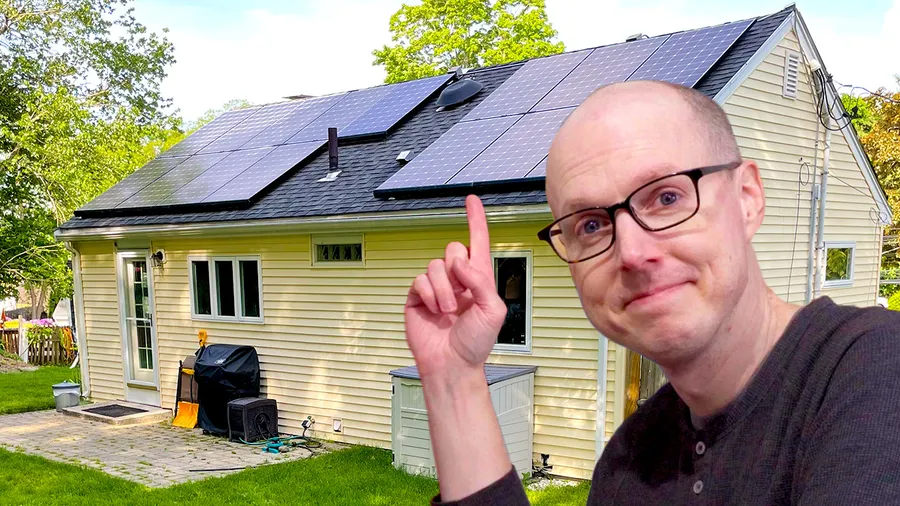
I know the battery math first-hand. My old house had a Tesla Powerwall. I loved it. My current house runs on Enphase solar and Enphase batteries. Also great. Also expensive. Also hit a wall with the permits.
So when a new category of home battery showed up, one that plugs into a standard wall outlet, needs no electrician, no permit, and moves with you when you move, unlike Nana's dolls … I paid attention. And I put three of them in my own house.
Quick disclosure. I'm an advisor to Pila, the company making these. That means I've spent real time talking with the team and giving them feedback on outreach and user experience. So this isn't a cold review. It's a story about a new battery category I’m genuinely excited about. But this is my first chance to actually live with the product. I'll tell you what works, what doesn't, and what it still can't do yet.
Because the real question isn't whether one battery is any good. It's whether this whole new category, the "home battery for the rest of us," actually lives up to the promise … especially for renters and apartment dwellers. And if it does, is this the version that’s about to go mainstream?
Why Home Batteries Fail Most People
Let's zoom out. My home battery problems aren't unique. They're limitations of the entire product category.
Right now, home batteries fail most people in four specific ways.
Start with the price tag. Before you charge up, your bank account gets seriously drawn down. A Powerwall installed runs fifteen thousand dollars and up.1 Enphase lands in the same neighborhood.2 And then there's the added costs of labor, the battery enclosure, and sometimes a panel upgrade … For most families, that's not a home upgrade. That's a car … or a kitchen renovation.
Then there's the install. You don't just buy a home battery, you begin an annoying home battery process. This requires a licensed electrician, permits, an inspection, and your utility signing off. Depending on where you live, the whole thing can take months.
Third, and this is the big one. Half of US households can't install a Powerwall at all.3 The whole-home battery category was built for the roughly 80+ million owner occupied single-family homes here in the US.4 5 6 Home batteries right now, are really just batteries for a minority of all homes. They're some homes batteries.
And last, home batteries don't move with you. You install one, congratulations, it's now a permanent part of the house. You sell the house, it stays. Move, and you either pay thousands to rip it out or you leave it behind. That's not a consumer electronics product. That's a kitchen renovation, or a lithium phosphate anchor.
Home batteries are expensive, complicated, exclude most of the market, and can't move with you. This is not a recipe for mass adoption. And I say this as someone who has owned two of them. I'm not against whole-home storage. I built my house around it. I'm just honest about what it can and can't do.
I don't mean to beat up on home batteries. Since 2015 and the original Powerwall, the category has basically been one big box doing all the work. Modular and portable products have helped at the edges, but none of them solve all four problems. What I'm about to show you does.
The New Category
So how does Pila solve these four huge problems with home batteries? It starts with a total reorientation of how home batteries work, and even how they work together.
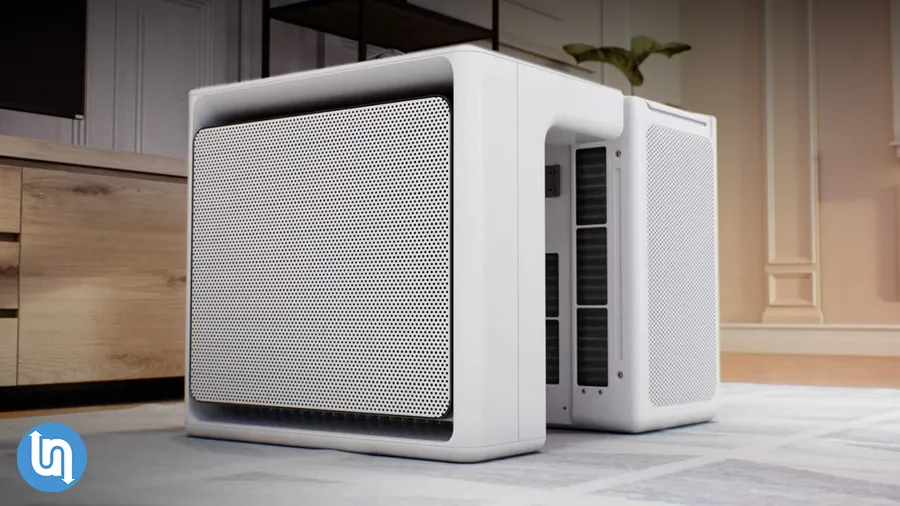
Pila calls their product a battery mesh operating system. Think mesh Wi-Fi, but for your home's energy. Remember when home Wi-Fi was one big router in a closet, and half your house had no signal? Mesh Wi-Fi fixed that with smaller units that talked to each other and coordinate. The old home battery is that single router. This new category is mesh.
A single Pila plugs into a standard 120-volt outlet. No electrician. 1.6 kilowatt-hours of storage. 2,400 watts continuous power. Plus a 3,600-watt surge for up to 30 seconds, and a 90-amp instant peak to kick on motor loads like a fridge compressor. And the units coordinate over a local network, so they keep talking even if your WiFi drops. It's a battery buddy system.
Put one in an apartment, and that could be your whole system. Put up to 64 in a house, and they all coordinate as one. The team is already testing meshes of 1,000+ units for whole apartment buildings. Start small. Scale up. Take them with you when you move.
Combined you've got something more than a battery. You've got the potential for an entire energy hub. How it actually pulls that off is worth its own section, so I'll come back to that in a minute.
The Catch
Now here's the part most reviews might gloss right over.
The Pila hardware is capable of feeding power back into your home through a standard outlet. Push and pull. That's how you would get true solar arbitrage and broader whole home energy distribution. That's how you would shave peak load during the day. That's the dream feature of this whole category. Being able to power other devices in your home without having them plugged directly into the Pila.
And right now, in the US, that is illegal … not to code.
The rules just haven't caught up. Our electrical code was written before a product like this existed. Plug-in solar, plug-in storage, bidirectional outlets, none of it fits the current rulebook.
But the wall is starting to crack. Twenty-eight states plus DC are actively considering plug-in solar and storage legislation.7 Utah was the first to pass a balcony solar bill, back in 2025.8 UL 3700, the safety standard this whole category needs, is actively being developed.9 And to be clear, Germany figured this out years ago.10 They're just ahead of us.
And one more thing worth noting. You don't have to wait for the code to change to help the grid. A lot of utilities already pay homeowners for demand response. Normally that means your A/C gets cut on the hottest day of the year. With a Pila, your A/C just shifts to stored power instead. You stay cool … and get paid. When the rules catch up, the ability to push power back into the wall outlet will roll out over time as utility pilots and codes allow. But here's my mantra. Buy the product for what it can do today. Not for the promise of what it might do tomorrow.
This is a regulatory wall, not a bug in the product. And the window to climb over it is almost open.
How It Actually Works
Right now, a Pila is super useful for backup and load shifting, and it'll get even more useful over time. So here's what it can do for you today.
Each Pila has WiFi and a cellular connection built in. But Pila built this with a local-first mindset, and that's the part I love. The units talk to each other over a local thread network, the same protocol a lot of smart home gear uses. If your WiFi drops or you live in a cellular dead zone, the batteries keep doing their job.
For the smart home nerds like me, that also means you can pull every Pila into Home Assistant locally. Full sensor data. Outlet-level control. No internet required. You get the benefit of Pila's app and software stack, but you stay in control of your hardware for the long haul. That's rare in this category and it's a big deal.
A Pila pulls data from four places. Your rooftop solar, currently Tesla and Enphase, but it can also use time and weather forecasting for solar coordination. Your utility, using smart regional defaults. Your appliances, because it meters every plug and learns each one's normal rhythm. And your smart home, through Home Assistant today with Alexa and Google Home coming this summer. I'll show you some real-world use cases in a minute.
Three modes
You can put the whole mesh, however many batteries you have, into one of three modes.
First up. Backup only. It's basic, but useful. The battery stays fully charged and only discharges when the power goes out. While it waits, grid power passes straight through, so nothing gets wasted converting AC to DC and back.
The second mode is Save me money mode. This is for homes on time-of-use rates. The battery charges when electricity is cheap, discharges when it's expensive. Now we're getting somewhere.
Then finally, there's maximize my solar mode. This is the one I'm running. It charges the battery with solar during the day, then discharges when the sun goes down.
You can also set a per-battery reserve, so each unit always holds a guaranteed chunk for backup. And there's a storm mode, which I've loved on my Powerwall and Enphase setups. If a big storm is forecast, the unit flips into backup mode automatically for energy security. You don't have to think about it. Unless you really want to, like me.
The display and the app
The hardware is designed to look like something you actually want in your house. Sleek. Not utilitarian. More nice piece of home gear than portable jobsite battery. Again, my apologies to the Ecoflow, I'm sure you're lovely.
Every Pila has a touchscreen on the front, and it does more than most product displays. Setup, WiFi, Home Assistant pairing, outlet control, mode settings, all right on the device. There's a live readout of your solar production and home energy use, an Energy Independence screen that shows how much of your power traces back to your own solar, and if you just want to use it as a clock, you can do that too. No mobile app required for any of it, which I appreciate.
The mobile app is where the data lives. Nice charts and graphs. Energy usage per Pila, and the whole mesh viewed as one. Runtime estimates. It's the dashboard view of everything the units are doing. This is every obsessive energy dad's dream made real. It's awesome.
Out of the Garage and Into the Home
OK. So what happens when you put three of these things into a house?
And why would someone who already has a whole home battery do this?
I'm not just some Matty who is batty for batteries. I'm just trying to get the most out of what I spend. When I built my home I wanted 25 to 30 kilowatt-hours of storage in the garage. I got stuck at 20. Any more capacity on that wall, and code in my area would have forced me to install a sprinkler system in the garage to keep going. That would have cost thousands of the dollars that home batteries are supposed to save.
So I had a gap. About 5 kilowatt-hours I couldn't add in a house where I'd already spent serious money on home storage. Pila let me make up the difference by putting three batteries in three different rooms. Let's take a little tour to see how this works.
Unit 1: The Home Office
I’ve got a red Pila standing vertically next to my desk, where I've got a Mac Studio plugged in, along with desktop speakers and a subwoofer. There's also a floor lamp and a desk lamp. Everything that runs a workday.
While I’m writing this very script, my office is pulling somewhere between 80 and 150 watts. The average is about 96. That gives me roughly 11 hours and 30 minutes of backup time from a single Pila, which is more than enough to ride through almost any outage I’d ever see. And because that desk runs off my rooftop solar through the Pila, my Energy Independence on that outlet reads 100%.
But for me, the party trick is the auto-shutoff. The Pila is hooked into my smart home. When I leave the office and the room is empty, the unit automatically powers down anything I’ve told it to. The back outlet running my speaker system goes dark, so there’s no phantom draw while I’m not in the room. I don’t have to think about it. The room just gets quieter and a little more efficient on its own.
And during the workday, the same unit is my backup. The desktop and monitors run off the Pila instead of straight from the wall. If the power goes out mid video render, which is the greatest fear of all YouTubers, I don’t even notice. The switchover takes 20 milliseconds. It's so fast I can't notice it, and neither can my gear.
Unit 2: The Network Closet
My second unit is in my network closet. This is the one the real nerds out there will be most excited about.
My network closet runs about 300 watts twenty-four hours a day, 365 days a year. And yes, that's a lot … but after all, I do run a business out of my home. That includes all the servers, switches, wifi access points in the house, security cameras … the whole Undecided With Matt Ferrell home and media tech stack. While I have a UPS battery on this setup, it will only run the rack for 10 minutes or so before it kicks out. It’s just enough time to get the computer gear turned off safely.
I plugged a Pila inline between the wall and the rack because this is one of the biggest energy sinks in my house. Pila helps offload energy use from my Enphase battery system, which means there’s more power available for things like my HVAC system.
And just like my office setup, when the power blips, the rack doesn't even flicker. No reboot. No lost work. No fighting with the firewall after a brown-out. And I get over 5 hours of backup instead of just 10 minutes from my lead acid battery UPS. The big win is shifting this load off of the Enphase batteries to extend that usage elsewhere in the house. This means more of my solar generation is getting stored and used locally.
Unit 3: The Main Home Theater
The third unit goes where everyone else does in my house each evening: my living room.
There's a lot of energy spent in this room, and I'm not just talking about arguing over what to watch. The TV is always on, and the home theater receiver is running, along with lamps, while my family sits down for a movie or a show. That load runs for three to four hours straight, every night.
The Pila here does two things. During normal hours, it runs the home theater off stored energy from my solar, which again helps extend my Enphase battery system. During an outage, it keeps the show going long enough that an outage doesn't turn into a family emergency, or worse, an insurrection.
And like in my home office, I use my smart home to switch off living room components to avoid phantom power drain.
The System Math
So what do all these indoor batteries add up to?
With three units in three rooms that's roughly 4.8 kilowatt-hours of additional storage. That is very close to the 5 kilowatt-hours I couldn't add to the garage because of the sprinkler rule. The gap I couldn't close with Enphase, I closed with three plug-in batteries in the rooms that needed them most.
And the Enphase system in the garage is a little happier for it. Or at least I think it's happy, it's more of a hummer than a talker. The loads I moved off the main system at night don’t need to get pulled from the garage batteries anymore. That makes more reserve for the rest of the house.
I’ve talked about this in previous videos about my home’s energy use, but I’m net zero across the course of a year. My solar panels produce as much power as I use. Day to day? That's a different story. How much I pull from my solar and battery setup versus the grid changes with the season.
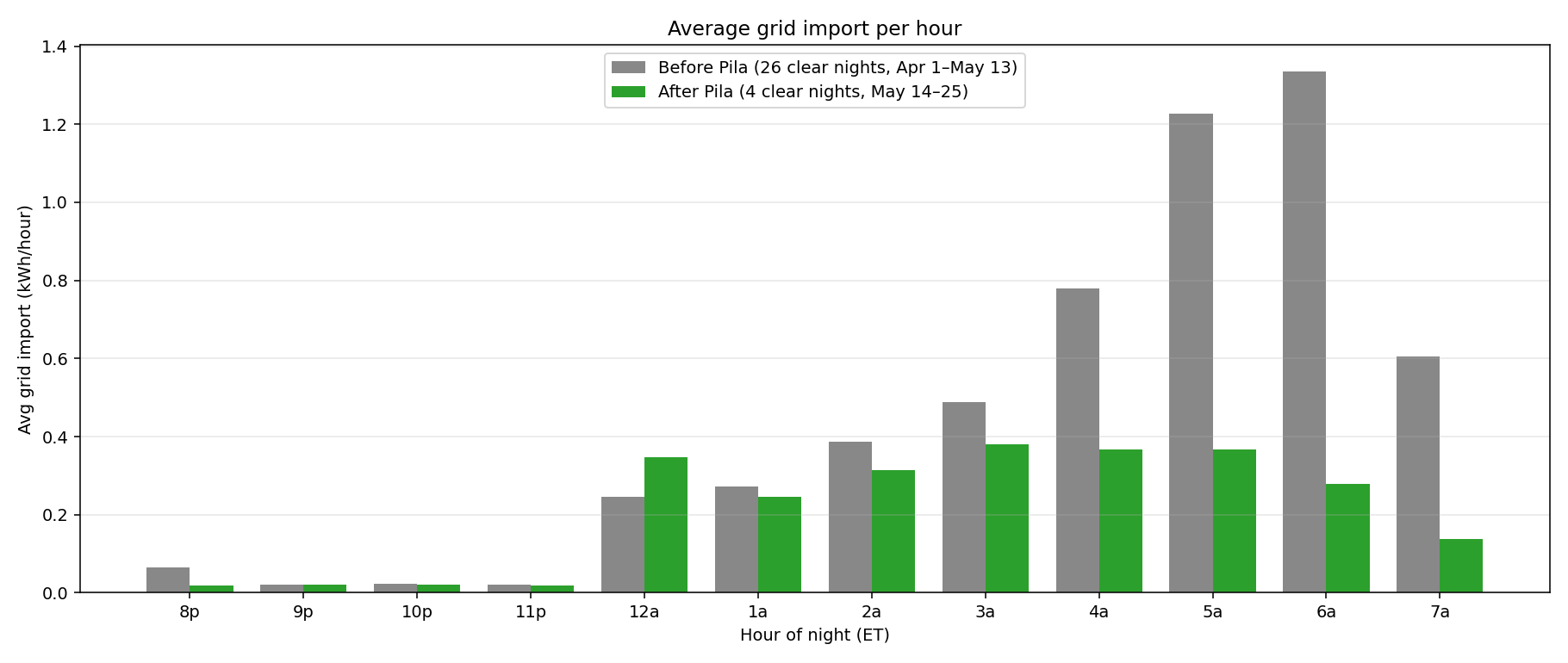
So I ran the numbers before and after the Pila mesh went in. On a typical night before Pila, my Enphase system used to pull a few kWh from the grid in the early morning hours just to bridge that pre-dawn gap. After Pila? Basically nothing.
That 4.8 kWh of Pila storage is doing exactly what I hoped. It covers the shortfall that used to push the Enphase batteries to their reserve. I’m making it through the full 24 hours on my own solar far more often than I used to.
Reality Check
OK. Time to put my honest hat back on. Because I said I would.
A Pila is not a whole-home backup. One unit at 1.6 kWh, or a three-pack at 4.8, is not going to run your whole house during a multi-day outage. An expansion accessory shipping later this year doubles each unit to 3.2 kWh, which raises the ceiling, but it still isn't enough to be a whole-home backup. And at the moment, the only things backed up have to be plugged directly into Pila. If what you need is a truly whole home solution, you need an Enphase or a Powerwall.
And if you've got an EV, Pila can't handle it. A Pila is not going to run a Level 2 EV charger that draws 7,200 watts continuously. Or your central HVAC heat pump system. But that’s not this product's job or intended use case.
One Pila unit is priced at $1,499. For a lot of stuff in the world right now pricing is a moving target. Raw materials, supply chain, tariffs, all of it in motion. I hope those factors don't make this category too expensive to build a custom base, but for now Pila’s price is locked in.
And competitors are coming. I can almost guarantee you that there are companies in China already working on copycats. In a weird way, that's a good thing. It means the category is real. But it also means the question of who you buy from starts to matter, because safety and software are the factors that will make the difference for consumers.
Verdict
So who is this actually for?
It's for renters and apartment dwellers who've never been able to own a home battery. It's for homeowners like me who hit a code limit. And it's for people who move, which is most of us, and don't want to leave thousands of dollars of hardware behind.
And the big question for why you’d want it? Well, that’s going to vary based on … well … you. I live in your screen, not in your head. But the big ones are energy security and saving money. Pila can keep your gear running through a blackout, whether that’s an office setup you need running to save your work, or your fridge running to save your produce from spoiling, or even your medicine. And if you have time of use rates, these batteries can shift when you use energy and save you big money every single year.
On the other hand, Pila is not for anyone who wants a Powerwall replacement today. And it's also not for anyone who wants a single unit to run their whole house.
Here's my take. The category matters more than the specific product. What Pila is doing is the first credible version of something that should have existed a decade ago. Home batteries shouldn't require an electrician, a permit, and a kitchen-renovation budget. They should plug in.
And that power gap in my garage, the one I thought I couldn't close, is filled, with three batteries across three rooms. It's a solution that works better than I could have expected.
Again, you should buy a product for what it can do today, not for the promise of something to come. But … why I'm excited about this product, and why I'm involved in this company is because of what it might do in the near future.
Imagine when the UL 3700 code gets passed and you can start to put energy back into a standard outlet in your home. That means a mesh Pila system will start to act like a mini virtual power plant right inside your house.
And expand that to a mid-size apartment building. 100 units at Pila scale is 160 to 320 kilowatt-hours of distributed storage, assembled from plug-in modules. The kind of system that would normally need a concrete pad, switchgear, and a year of permitting. Pila gets it there in minutes. It's why 34 states now have virtual power plant programs paying homeowners for using their batteries.11 I'm in one of those programs.
I’m extremely excited by this new battery category and think it has a lot of potential.
- EnergySage: Solar battery cost: Are they actually worth it in 2026? ↩
- NRG Clean Power: How Much Does a Solar Battery Cost? (2026 Guide) ↩
- Housing Vacancies and Homeownership, Q1 2026 ↩
- U.S. single-family homes – statistics & facts ↩
- Housing Inventory Estimate: Total Housing Units in the United States ↩
- Statistics of U.S. Businesses (SUSB) ↩
- Canary Media: Balcony solar is taking state legislatures by storm ↩
- Utah Legislature: H.B. 340 Solar Power Amendments ↩
- UL Solutions: Debuts Testing and Certification Framework for Safer Plug-In Solar Across the United States ↩
- German Federal Ministry: How exactly do plug-in solar installations work? ↩
- Canary Media: More states look to virtual power plants ↩